|
Whaling With
Savik Crew in Spring and Fall
Excerpts from The
Whale and the Supercomputer. I took these photographs at the
same time as the events described (the photos do not appear in the
book).
|
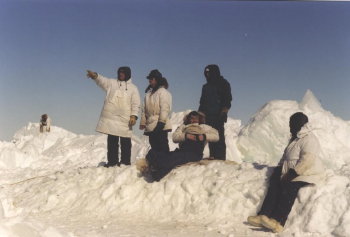
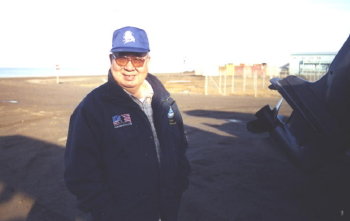
Ultimately, Richard Glenn (at right)
abandoned the degree with only the
writing of the dissertation left to do. Partly, life became too busy
with
’Berta’s arrival and the gas field project to finish. But he also
became
uncomfortable with the idea of having the degree at all. He saw a lack
of
Iñupiaq humility in the basic assumption of his project, the
idea that he could
take traditional knowledge to a higher, scientific level. Through two
years of
study, he had discovered how little he really knew. What he had learned
instead
was that traditional knowledge existed as an organic part of a person
living in
the environment, a whole world constructed from experience, and
couldn’t be
extracted and rationalized into datapoints. “I didn’t want to become
the ice
man, the expert in a town full of experts, some kid from California
that thinks he knows everything,” he said. “To me, it’s not so much
about
finishing a degree as continuing to learn about this life.”
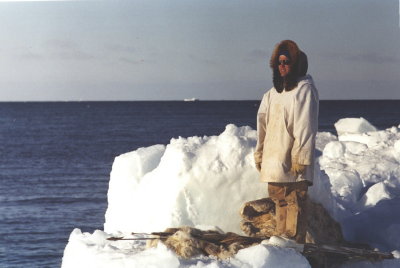
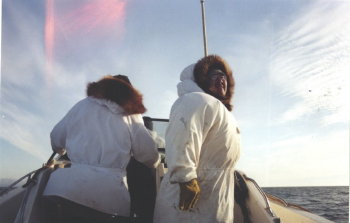
As he made that statement, Richard
stood on white ice in
pale sunlight, gazing over the sea from inside the hood of his white
hunter’s
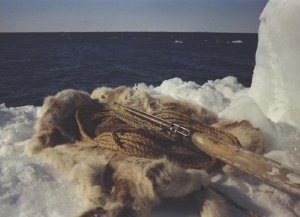
parka. We snacked on a frozen caribou haunch. The waves were up a bit,
so Savik
Crew was not boating, instead just waiting for a whale to surface
nearby, the
harpoon and shoulder gun laid out with care at a high
point on the ice edge. Waves boomed and
reverberated
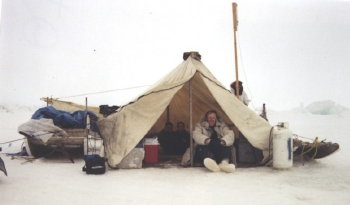
underneath, so Richard had moved the snowmachines back a little; the
camp with
the tent was well back among the multi-year ice. My questions were a
distraction from his quiet watching until I asked one that really
interested
him, made him think: which way did he know more about ice, as a
scientist or as
an Iñupiaq? He debated with himself a bit before he answered: He
knew more as
an Eskimo. Scientists, he observed, know a collection of facts about
ice;
Eskimos know ice itself. “The best ice scientist is almost an
Iñupiaq,” he
said. “If he’s a good ice scientist, then he’s thinking the way these
people
here do.”
|
|
|
|
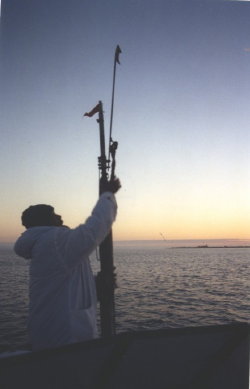
First light showed an ocean perfect
for whaling. A rich rim
of gold emanating from the eastern horizon held up a sky dome of
velvety blue.
Roy and his crew climbed the high gunwales of Savik Crew’s fall whaling
boat
while it still sat on the trailer and Richard took the wheel of the
pickup
truck to back it down the ramp on the beach near NAPA.
Then he unhitched and left for work. Lots of boats and crews were
launching and
floating just offshore. The air was sharp with the fall chill and the
excitement of the moment amid the scent of the sea and fuel. Roy
opened the bomb box and prepared the weapons, heavy gear thumping on
the fiberglass
deck, sounds flattened by the surrounding sea. Eben took his place with
the
harpoon ready on the foredeck. In the aft, the grub box yielded metal
Thermoses
of hot coffee and store-bought cinnamon rolls. Roy
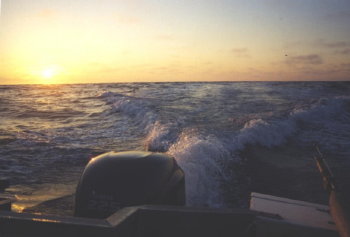
pushed the throttle lever forward and we flew out into the Arctic
Ocean, directly away from Barrow. A long swell from the
north
lifted us in slow rhythm
These waves came from far away, built
over hundreds of miles
of open water where the pack ice had retreated. A few months later,
scientists
from Boulder confirmed its unprecedented distance when they announced
that the
ice had shrunk farther than ever before measured with passive microwave
satellites first launched in the 1970s, the result of a warm, stormy
summer
that broke and melted the pack. Arctic sea ice was smaller than the
long-term
average by a million square kilometers, or 14 percent, and much of the
retreat
was on the Alaska and Siberia
side. The ice also was thinner and less compact, even at its center.
Jim
Maslanik, a co-author of the study, said the ice extent was probably
the lowest
in fifty years. It was as if a continent were disappearing.
(Eben at top, Roy center, Savik at bottom.)
|
|
|
